Endüstri Tarihine Kısa Bir Yolculuk (önemli!)

Endüstri 4.0 ya da 4. Sanayi Devrimi, birçok çağdaş otomasyon sistemini, veri alışverişlerini ve üretim teknolojilerini içeren kollektif bir terimdir. Bu devrim nesnelerin interneti, internetin hizmetleri ve siber-fiziksel sistemlerden oluşan bir değerler bütünüdür. Aynı zamanda bu yapı akıllı fabrika sisteminin oluşmasında büyük rol oynar. Bu devrim, üretim ortamında her bir verinin toplanmasına ve iyi bir şekilde izlenip analiz edilmesine olanak sağlayacağı için daha verimli iş modelleri ortaya çıkacaktır. İçeriğimizde bu sanayi devrimlerinin detaylarını bulabilirsiniz..

İlk sanayi devrimi (1.0) su ve buhar gücünü kullanarak mekanik üretim sistemleri ile ortaya çıktı. İkinci sanayi devrimi(2.0) ile elektrik gücünün yardımıyla seri üretim tanıtılmıştı. Üçüncü sanayi devriminde (3.0) ise dijital devrim, elektroniklerin kullanımı ve BT (Bilgi Teknolojileri)’nin gelişmesiyle üretim daha da otomatikleştirildi. Şimdi dördüncü sanayi devrimi (4.0)’ı incelemeden önce bu gelişimi bir de tarihsel olarak inceleyelim.

Endüstri 1.0’dan 4.0’a Doğru

► Mekanik Üretim Tesislerinin Uygulanması (18. Yüzyıl)

  • 1712 Buhar Makinesinin İcadı

► Elektrik ve İş Bölümüne Dayalı Seri Üretime Geçilmesi

  • (19. Yüzyıl) 1840 Telgraf ve 1880 Telefon İcatları
  • 1920 Taylorizm (Bilimsel yönetim)

► Üretim Süreçlerinin Otomasyonu (20. Yüzyıl)

  • 1971 İlk mikro bilgisayar (Altair 8800)
  • 1976 Apple I (S. Jobs ve S. Wozniak)

► Otonom Makineler ve Sanal Ortamlar (21. Yüzyıl)

  • 1988 AutoIDLab. (MIT)
  • 2000 Nesnelerin İnterneti
  • 2010 Hücresel Taşıma Sistemi
  • 2020 Otonom Etkileşim ve Sanallaştırma

Şekil 1: Endüstri’nin Tarihsel Gelişimi

Endüstri 4.0’ın Yapısı


Endüstri 4.0, teknolojilerin ve değer zinciri organizasyonları kavramlarının kolektif bir bütünüdür. Siber-Fiziksel sistemlerin kavramına, nesnelerin, internetine ve hizmetlerin internetine dayalıdır. Bu yapı akıllı fabrikalar vizyonunun oluşmasına büyük katkı sağlar. Endüstri 4.0 genel olarak aşağıdaki 3 yapıdan oluşmaktadır.

► Nesnelerin İnterneti

► Hizmetlerin İnterneti

► Siber-Fiziksel Sistemler

Endüstri 4.0 ile modüler yapılı akıllı fabrikalar kapsamında, fiziksel işlemleri siber-fiziksel sistemlerle izlemek, fiziksel dünyanın sanal bir kopyasını oluşturmak ve merkezi olmayan kararların verilmesi hedeflenmektedir. Nesnelerin interneti ile siber-fiziksel sistemler birbirleriyle ve insanlarla gerçek zamanlı olarak iletişime geçip işbirliği içinde çalışabilecektir. Hizmetlerin interneti ile hem iç hem de çapraz örgütsel hizmetler sunulacak ve değer zincirinin kullanıcıları tarafından değerlendirilecektir.

Endüstri 4.0’ın Prensipleri

Endüstri 4.0, 6 prensibe dayanmaktadır.

1) Karşılıklı Çalışabilirlik: Siber fiziksel sistemlerin yeteneği ile (örn. iş parçası taşıyıcıları, montaj istasyonları ve ürünleri) nesnelerin interneti ve hizmetlerin interneti üzerinden insanların ve akıllı fabrikaların birbirleriyle iletişim kurmasını içerir.

2) Sanallaştırma: Bu yapı akıllı fabrikaların sanal bir kopyasıdır. Sistem, sensör verilerinin sanal tesis ve simülasyon modelleri ile bağlanmasıyla oluşur.

3) Özerk Yönetim: Siber-Fiziksel sistemlerin akıllı fabrikalar içinde kendi kararlarını kendi verme yeteneğidir.

4) Gerçek-Zamanlı Yeteneği: Verileri toplama ve analiz etme yeteneğidir. Bu yapı anlayışın hızlıca yapılmasını sağlar.

5) Hizmet Oryantasyonu: Hizmetlerin interneti üzerinden siber-fiziksel sistemler, insanlar ve akıllı fabrika servisleri sunulmaktadır.

6) Modülerlik: Bireysel modüllerin değişen gereklilikleri için akıllı fabrikalara esnek adaptasyon sistemi sağlar.

Endüstri 4.0 Sistemin Uygulanabilirliği

Endüstri 4.0 sistemindeki üretim, makinelerin hizmet sundukları ve ürünlerle gerçek zamanlı olarak bilgi paylaştıkları bir sisteme benzetilmektedir. Alman Yapay Zeka Araştırma Merkezi (DFKI), içinde Siemens’in de bulunduğu 20 endüstriyel ve araştırma ortağının katkısıyla kurulan Almanya, Kaiserslautern’deki küçük bir akıllı fabrikada bu gibi bir sistemin uygulamada nasıl çalışacağını sergilemektedir. Ürünler ile imalat makinelerinin birbirleriyle nasıl haberleşebileceklerini göstermek için sabun şişelerinden faydalanmaktadır. Boş sabun şişelerinin üzerinde radyo frekansıyla tanımlama (RFID) etiketleri vardır ve bu etiketler aracılığı ile makinelerin şişelerin rengini tanıması sağlanmaktadır. Bu sistem sayesinde bir ürünün radyo sinyalleriyle ilettiği bilgiler, üretimin başında itibaren dijital ortamda saklanmasına olanak sağlanmaktadır. Bu şekilde bir siber-fiziksel sistem olarak ortaya çıkmaktadır.

Endüstri 4.0’ın Avantajları


► Sistemin izlenmesinin ve arıza teşhisinin kolaylaştırılması

► Sistemlerin ve bileşenlerinin öz farkındalık kazanması

► Sistemin çevre dostu ve kaynak tasarrufu davranışlarıyla sürdürülebilir olması

► Daha yüksek verimliliğin sağlanması

► Üretimde esnekliğin arttırılması

► Maliyetin azaltılması

► Yeni hizmet ve iş modellerinin geliştirilmesi


kaynak:http://www.endustri40.com/endustri-tarihine-kisa-bir-yolculuk/

Dijital Dönüşüm ve Endüstri 4.0

Geleneksel üretim ve hizmet sistemleri, günümüzde dijital bir dönüşüm yaşayarak yeni bir yapıya bürünmektedir. Özellikle elektronik, bilgi ve iletişim teknolojilerinde yaşanan gelişmeler bu dönüşümü daha da hızlandırmıştır. Akıllı robotlar, sensörler, 3D yazıcılar, dronelar, gelişmiş veri depolama ve analiz sistemleri ve daha birçok teknoloji bu dönüşümde kilit rol oynamaktadır.Fiziksel objelerin Interneti olarak bilinen Internet of Things (IoT) sayesinde, birbirleri ile konuşabilen akıllı ve bağlantılı sistemler geliştirilmektedir. Kendi kendini yönetebilen, denetleyen ve optimize eden bu otonom sistemler hayatımızı şekillendirmeye başlamıştır. Şirketler açısından değer zincirleri yeniden oluşmakta, yöneticiler kararlarını bu yeni çağın gerekliliklerine göre vermek ve değişime ayak uydurmak zorundadır.

12 Nisan 2016, İstanbul

http://summit.itu.edu.tr/?gclid=CKr5646AqMsCFUefGwodlEAB9A

How big data can improve manufacturing

Manufacturers taking advantage of advanced analytics can reduce process flaws, saving time and money.

In the past 20 years or so, manufacturers have been able to reduce waste and variability in their production processes and dramatically improve product quality and yield (the amount of output per unit of input) by implementing lean and Six Sigma programs. However, in certain processing environments—pharmaceuticals, chemicals, and mining, for instance—extreme swings in variability are a fact of life, sometimes even after lean techniques have been applied. Given the sheer number and complexity of production activities that influence yield in these and other industries, manufacturers need a more granular approach to diagnosing and correcting process flaws. Advanced analytics provides just such an approach.

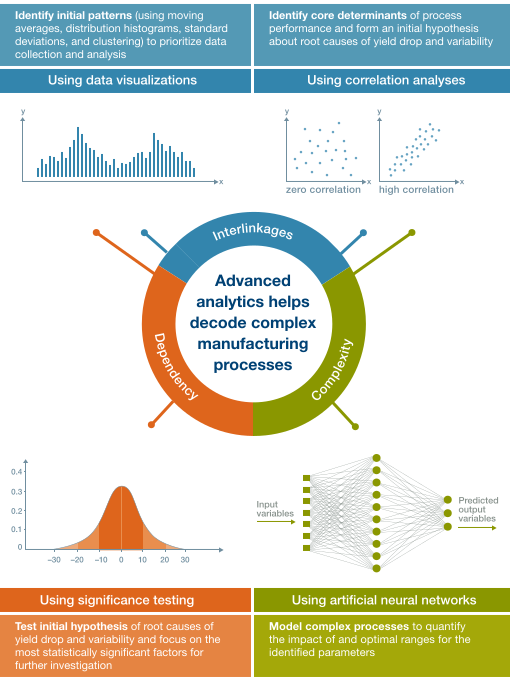
Advanced analytics refers to the application of statistics and other mathematical tools to business data in order to assess and improve practices (exhibit). In manufacturing, operations managers can use advanced analytics to take a deep dive into historical process data, identify patterns and relationships among discrete process steps and inputs, and then optimize the factors that prove to have the greatest effect on yield. Many global manufacturers in a range of industries and geographies now have an abundance of real-time shop-floor data and the capability to conduct such sophisticated statistical assessments. They are taking previously isolated data sets, aggregating them, and analyzing them to reveal important insights.

Consider the production of biopharmaceuticals, a category of healthcare products that includes vaccines, hormones, and blood components. They are manufactured using live, genetically engineered cells, and production teams must often monitor more than 200 variables within the production flow to ensure the purity of the ingredients as well as the substances being made. Two batches of a particular substance, produced using an identical process, can still exhibit a variation in yield of between 50 and 100 percent. This huge unexplained variability can create issues with capacity and product quality and can draw increased regulatory scrutiny.

One top-five biopharmaceuticals maker used advanced analytics to significantly increase its yield in vaccine production while incurring no additional capital expenditures. The company segmented its entire process into clusters of closely related production activities; for each cluster, it took far-flung data about process steps and the materials used and gathered them in a central database.

A project team then applied various forms of statistical analysis to the data to determine interdependencies among the different process parameters (upstream and downstream) and their impact on yield. Nine parameters proved to be most influential, especially time to inoculate cells and conductivity measures associated with one of the chromatography steps. The manufacturer made targeted process changes to account for these nine parameters and was able to increase its vaccine yield by more than 50 percent—worth between $5 million and $10 million in yearly savings for a single substance, one of hundreds it produces.

Developing unexpected insights

Even within manufacturing operations that are considered best in class, the use of advanced analytics may reveal further opportunities to increase yield. This was the case at one established European maker of functional and specialty chemicals for a number of industries, including paper, detergents, and metalworking. It boasted a strong history of process improvements since the 1960s, and its average yield was consistently higher than industry benchmarks. In fact, staffers were skeptical that there was much room for improvement. “This is the plant that everybody uses as a reference,” one engineer pointed out.

However, several unexpected insights emerged when the company used neural-network techniques (a form of advanced analytics based on the way the human brain processes information) to measure and compare the relative impact of different production inputs on yield. Among the factors it examined were coolant pressures, temperatures, quantity, and carbon dioxide flow. The analysis revealed a number of previously unseen sensitivities—for instance, levels of variability in carbon dioxide flow prompted significant reductions in yield. By resetting its parameters accordingly, the chemical company was able to reduce its waste of raw materials by 20 percent and its energy costs by around 15 percent, thereby improving overall yield. It is now implementing advanced process controls to complement its basic systems and steer production automatically.

Meanwhile, a precious-metals mine was able to increase its yield and profitability by rigorously assessing production data that were less than complete. The mine was going through a period in which the grade of its ore was declining; one of the only ways it could maintain production levels was to try to speed up or otherwise optimize its extraction and refining processes. The recovery of precious metals from ore is incredibly complex, typically involving between 10 and 15 variables and more than 15 pieces of machinery; extraction treatments may include cyanidation, oxidation, grinding, and leaching.

The production and process data that the operations team at the mine were working with were extremely fragmented, so the first step for the analytics team was to clean it up, using mathematical approaches to reconcile inconsistencies and account for information gaps. The team then examined the data on a number of process parameters—reagents, flow rates, density, and so on—before recognizing that variability in levels of dissolved oxygen (a key parameter in the leaching process) seemed to have the biggest impact on yield. Specifically, the team spotted fluctuations in oxygen concentration, which indicated that there were challenges in process control. The analysis also showed that the best demonstrated performance at the mine occurred on days in which oxygen levels were highest.

As a result of these findings, the mine made minor changes to its leach-recovery processes and increased its average yield by 3.7 percent within three months—a significant gain in a period during which ore grade had declined by some 20 percent. The increase in yield translated into a sustainable $10 million to $20 million annual profit impact for the mine, without it having to make additional capital investments or implement major change initiatives.

Capitalizing on big data

The critical first step for manufacturers that want to use advanced analytics to improve yield is to consider how much data the company has at its disposal. Most companies collect vast troves of process data but typically use them only for tracking purposes, not as a basis for improving operations. For these players, the challenge is to invest in the systems and skill sets that will allow them to optimize their use of existing process information—for instance, centralizing or indexing data from multiple sources so they can be analyzed more easily and hiring data analysts who are trained in spotting patterns and drawing actionable insights from information.

Some companies, particularly those with months- and sometimes years-long production cycles, have too little data to be statistically meaningful when put under an analyst’s lens. The challenge for senior leaders at these companies will be taking a long-term focus and investing in systems and practices to collect more data. They can invest incrementally—for instance, gathering information about one particularly important or particularly complex process step within the larger chain of activities, and then applying sophisticated analysis to that part of the process.


The big data era has only just emerged, but the practice of advanced analytics is grounded in years of mathematical research and scientific application. It can be a critical tool for realizing improvements in yield, particularly in any manufacturing environment in which process complexity, process variability, and capacity restraints are present. Indeed, companies that successfully build up their capabilities in conducting quantitative assessments can set themselves far apart from competitors.

Facebook’tan güvenlik durumu kontrolü

Sosyal paylaşım ağı Facebook, daha önce Paris saldırıları sırasında yaptığı ‘güvenlik durumu kontrolü’ uygulaması Ankara’daki saldırının ardından da başlattı. Uygulamayla, Ankara patlamasında yakında olanlar, güvende olup olmadıklarını bildirebiliyor.

Facebook’un 2014 yılında Japonya’da yayına alınan ‘Safety Check’ (güvenlik durumu kontrolü) özelliği, doğal felaketler ya da terör saldırıları sonrası insanların yakınlarından haberdar olmasını sağlıyor.

Uygulama şöyle çalışıyor; Facebook’a en son giriş yaptığınız yer baz alınarak yakınınızda bir felaket olduysa kullanıcıya bildirim gönderiliyor. Kullancılar kendilerine sunulan “Güvendeyim” ya da “Felaket bölgesinde değilim” seçeneklerinden birini tercih ederek arkadaşlarını durumu hakkında bilgilendirebiliyor.

FACEBOOK İLK KEZ PARİS’TE YAPTI

Facebook’un Paris’te meydana gelen saldırı neticesinde ilk kez hayata geçirdiği güvenlik durumu kontrolü, daha sonra en az 32 kişinin hayatını kaybettiği Nijerya’daki intihar saldırısının ardından kullanıma sunuldu.

http://www.hurriyet.com.tr/facebooktan-guvenlik-durumu-kontrolu-40056895

Bir tersine lojistik örneği:Toyota 2,9 milyon aracını geri çağırıyor

Japon otomobil üreticisi Toyota, emniyet kemeri sorunu nedeniyle dünya genelinde 2,9 milyon aracını geri çağıracağını açıkladı.

Reuters haberine göre, Şirketten yapılan açıklamada, emniyet kemerlerinin koltuk kenarlarına takılı metal kısımlarından zarar görme ihtimali olmasından geri çağırma kararı alındığı ifade edildi.

Durumu e-posta ile duyuran dünyanın en büyük otomobil üreticisi geri çağrılacak araçların Temmuz 2005-Ağustos 2014 arasında üretilen ve tüm dünyaya satılan RAV4 SUV modeli ve Ekim 2005 ile Ocak 2016 arasında üretilen ve sadece Japonya’da satılan Vanguard SUV modellerini de kapsadığını da duyurdu.

Geri çağrılacak otomobillerden 1,3 milyonu Kuzey Amerika’da olacak.

Şirket Avrupa’da da 625 bine yakın aracı geri çağıracak. Buna ek olarak Çin’de 434 bin otomobil, Japonya’da 177 bin otomobil ve dünyanın diğer bölgelerinde toplam 307 bin otomobil geri çağırma kapsamından bakımdan geçirilecek.

Şirketlerin araç geri çağırmaları, hatalı kısımları düzeltip, tüketicilere araçlarını kusursuz bir şekilde geri vermek anlamına geliyor ve bunun karşılığında herhangi bir ücret alınmıyor.

http://www.hurriyet.com.tr/toyota-2-9-milyon-aracini-geri-cagiriyor-40056916

Digitizing the value chain

Challenges remain for “Industry 4.0,” but the buzz is growing.

March 2015 | byJohn Nanry, Subu Narayanan, and Louis Rassey

Digital manufacturing and design are drawing attention from innovators and investors alike. Sometimes referred to as “Industry 4.0” (especially in Europe) or as the “Industrial Internet” (General Electric’s term), these labels reflect a basket of new digitally-enabled technologies that include advances in production equipment (including 3-D printing, robotics, and adaptive CNC mills1 ), smart finished products (such as connected cars and others using the Internet of Things), and data tools and analytics across the value chain.

These technologies are changing how things are designed, made, and serviced around the globe. In combination, they can create value by connecting individuals and machines in a new “digital thread” across the value chain—making it possible to generate, securely organize, and draw insights from vast new oceans of data. They hold the potential for disruptive change, analogous to the rise of consumer e-commerce. In 2010, when some two billion people connected online, the Internet contributed approximately $1.7 trillion to global GDP.2 What’s in store when 50 billion smart machines—deployed across factory floors, through supply chains, and in consumers’ hands—can connect with one another?

Competitors and policymakers are pooling their efforts to make that happen. In the past year, for example, more than 200 organizations from industry, government, and academia joined in supporting the Digital Manufacturing and Design Innovation Institute (DMDII) to advance digital integration in the manufacturing economy. Participants have committed more than $200 million to support the DMDII, and the US federal government is contributing an additional $70 million. Companies such as Caterpillar, GE, and P&G are among the industry partners. But even as the holy grail of a digitized value chain draws closer, industry leaders are expressing some prominent, common concerns.

McKinsey had an opportunity to poll executives at companies participating in the DMDII.3 While 80 percent of the respondents consider digital manufacturing and design to be a critical driver of competitiveness, only 13 percent rate their organizations’ digital capability as “high” (exhibit). And even among those leaders, many believe that their firms and their industries currently lack necessary standards, data-sharing, and cybersecurity capabilities.

Exhibit

Industry executives report that digital capabilities fall well short of current aspirations.

Across industries, executives at several manufacturers identified a need for dramatic improvements in certain software applications. Reporting dissatisfaction with some vendors’ products in areas such as computer-aided design (CAD), enterprise resource planning (ERP), and manufacturing execution systems (MES), these executives cited examples of applications they found too hard to learn, too slow to evolve and adapt, and sometimes too expensive for small businesses. Some systems are also closed—they don’t communicate with each other or allow others to build upon them. Achieving the transformative potential from digital manufacturing, by contrast, requires information systems that are open, interoperable, and user-friendly.

Successful implementation of digital-manufacturing solutions entails fluid digital communication across the value chain—this continuous flow of data is the digital thread. In response, a number of legacy software vendors, to their credit, are striving to capture a share of this new market. But it’s an open question whether they can move fast enough. The evolution of the consumer Internet does offer some insight for its more nascent industrial counterpart. Today’s consumer-based apps and cloud-based software, for example, are updatable, affordable for the masses, and intuitive to use. Manufacturing leaders yearn for design and manufacturing software solutions and for an app-store ecosystem that can reach the same bar.

Enabling individuals and machines to communicate seamlessly would of course make production more cost efficient. But perhaps more compellingly, digitizing the value chain facilitates innovation and can directly improve the top line. For example, the aggregation and analysis of data across a product’s life cycle can increase the uptime of production machinery, reduce time to market, and make it possible to understand the product’s consumers. They also make product innovation less about “tribal knowledge” and gut feeling and more of an exercise in analyzing, testing, and responding to hard data and robust simulations.

To that end, the leaders we surveyed were particularly bullish about the impact of digital technologies on product development and design. When they were asked to rank the specific value-chain areas that would benefit most from digitization, one of the highest was the “design–make” link—including the ability to compare “as designed” intent with “as made” data from factories or to predict the quality of new products by using real-time simulations that leverage actual factory data.

Digital manufacturing is already proving its potential to create value at points beyond the design phase. Coca-Cola applied a flexible packaging process in its “Share a Coke” campaign, in which firms collaborated throughout the supply chain and helped increase the company’s soft-drink volumes across world markets. Daimler has rolled out “Mercedes me,” which, among other features, tracks the usage and wear of key automotive parts to help service automobiles more effectively. (For more, see “Marketing the Mercedes way.”) It’s important that the opportunities from digital manufacturing are not just for big corporations. Micro-manufacturers, for example, are using Etsy’s wholesale program as a digital distribution platform to scale themselves up to multimillion-dollar enterprises.

With compelling opportunities across the digital thread, venture-capital firms and other investors will continue to take notice. GE Ventures, for one, opened a Chicago office in 2014, drawn in large part by opportunities to apply digital manufacturing in America’s industrial heartland. Manufacturing remains, after all, a massive driver of the global economy, representing approximately 16 percent of global GDP.4 With those stakes, even marginal improvements will unlock significant wealth.

About the authors

John Nanry is a consultant in McKinsey’s Chicago office, where Subu Narayanan is an associate principal and Louis Rassey is a principal.

The authors wish to thank William King, the DMDII’s chief technology officer, for his insights on this topic and for providing access to the DMDII data.

The authors also wish to acknowledge Aaron Katarya for his contribution to this article.

reference: http://www.mckinsey.com/insights/manufacturing/digitizing_the_value_chain

Are you ready for 3-D printing?

There have been false dawns before, but this technology is poised to deliver cost benefits and to advance innovation in manufacturing.

February 2015 | byDaniel Cohen, Katy George, and Colin Shaw

Systems for additive manufacturing, or 3-D printing as it’s better known, represent just a fraction of the $70 billion traditional machine-tool market worldwide.1 Yet given the likelihood that this technology will start to realize its promise over the next five to ten years, many leading companies seem surprisingly unaware of its potential—and poorly organized to reap the benefits.

A McKinsey survey of leading manufacturers earlier this year showed that 40 percent of the respondents were unfamiliar with additive-manufacturing technology “beyond press coverage.” An additional 12 percent indicated that they thought 3-D printing might be relevant but needed to learn more about it (Exhibit 1). Many also admitted that their companies were ill prepared to undertake a cross-organizational effort to identify the opportunities. Two-thirds said that their companies lacked a formal, systematic way to catalog and prioritize emerging technologies in general.

Exhibit 1:  How 3-D printing is set to become more relevant

The mass adoption of 3-D printing—the production of physical items layer by layer, in much the same way an inkjet printer lays down ink—is probably years rather than months away. The 3-D printer industry has enjoyed double-digit growth recently; sales of metal printers, indeed, rose by 75 percent from 2012 to 2013. But expert consensus2indicates that the market penetration is just a fraction (1 to 10 percent) of what it could be given the wide range of possible 3-D applications (Exhibit 2).

Exhibit 2: The wide range of possible 3-D applications suggests that market penetration could increase dramatically.

Ten percent of the executives in our survey already find the technology “highly relevant.” They see 3-D printing’s ability to increase geometric complexity and reduce time to market as the key business benefits, closely followed by reduced tooling and assembly costs. Those who expect to be among the next wave of users were much more likely to cite reducing inventories of spare parts as one of the advantages. Additive manufacturing, in short, seems set to change the way companies bring their products to market and respond to customer needs. But predicting a “tipping point” is difficult.

Much will depend on when and how quickly overall printing costs fall, a development that should narrow the still-yawning gap between the cost of new and traditional manufacturing methods. In sintering-based 3-D printing technologies,3 for example, there are two major expense categories. The machines and their maintenance typically account for 40 to 60 percent of total printing costs. The materials used in the manufacturing process can account for 20 to 30 percent when using common materials such as aluminum, or 50 to 80 percent when printing with exotic materials such as titanium. Labor and energy make up the rest.

In all likelihood, prices for sintering-based printers will remain steady or rise in the near term thanks to the introduction of new technical features, such as enhanced automation. But patent expirations and new entrants in Asia should apply downward pressure over the next ten years. The cost of materials ought to drop in the long term as third-party firms become credible alternative powder suppliers and as increased demand for powder enhances scale efficiencies more generally. Throughput rates are expected to increase on the back of growing laser power, higher numbers of lasers, and better projection technology. All of that will serve to reduce expensive machine time.

Our research on sintering-based printers examined two possibilities. In the “base” scenario, costs remain largely at their present level and companies come to understand the benefits of additive manufacturing only gradually. In the “market shock” scenario, printing costs fall precipitously—say, by 30 or even 50 percent over a ten-year period. Early signs of these cost-shifting dynamics can be seen in plastic sintering. One new Chinese entrant is already selling comparable selective laser-sintering machines at a price 25 to 30 percent below that of a leading Western supplier. Asian players are offering technically comparable nylon powders at prices that are more than 30 percent lower than those of their Western rivals. Price undercutting is less dramatic for nontraditional blends, such as carbon-filled powders used in strong but lightweight parts (those in racing cars, for example).

While there have been false dawns before for 3-D printing as a whole, companies cannot afford to be complacent. That will be especially true if the expected benefits to innovation are not only magnified by cost reductions but also bring into scope whole new industries and product categories. CEOs and COOs above all need to examine the readiness of their companies for a future in which a range of integrated digital technologies (of which 3-D could be one of the most significant) will dominate manufacturing and competitors will probably be building additive manufacturing into their value chains. That means focusing on better organizational cohesion and considering partnerships with external organizations (such as local contract-printing bureaus) that have the necessary technical expertise.

Beyond the C-suite, companies should build a group of executive champions within the engineering, quality, operations, and procurement units. Some aerospace and medical-device companies, for example, already have teams scanning their entire design portfolios for parts that could benefit from this technology. Furthermore, the introduction of 3-D printing into complex manufacturing environments would require big changes in quality-assurance and control processes: companies would have to replace old protocols relying on extensive up-front testing and validation of traditional production tools, such as molds. Since additive manufacturing reduces or even eliminates the need for these tools, organizations must understand the steps needed to satisfy their quality requirements in the future.

The coming years will bring new opportunities and challenges. Companies with savvy executives who raise awareness, fill talent gaps, and build the necessary organizational capabilities will be well positioned to benefit from this breakthrough technology.

source: http://www.mckinsey.com/insights/manufacturing/are_you_ready_for_3-d_printing

The seven traits of effective digital enterprises

To stay competitive, companies must stop experimenting with digital and commit to transforming themselves into full digital businesses. Here are seven traits that successful digital enterprises share.

The age of experimentation with digital is over. In an often bleak landscape of slow economic recovery, digital continues to show healthy growth. E-commerce is growing at double-digit rates in the United States and most European countries, and it is booming across Asia. To take advantage of this momentum, companies need to move beyond experiments with digital and transform themselves into digital businesses. Yet many companies are stumbling as they try to turn their digital agendas into new business and operating models. The reason, we believe, is that digital transformation is uniquely challenging, touching every function and business unit while also demanding the rapid development of new skills and investments that are very different from business as usual. To succeed, management teams need to move beyond vague statements of intent and focus on “hard wiring” digital into their organization’s structures, processes, systems, and incentives.

There is no blueprint for success, but there are plenty of examples that offer insights into the approaches and actions of a successful digital transformation. By studying dozens of these successes—looking beyond the usual suspects—we discovered that effective digital enterprises share these seven traits.

1. Be unreasonably aspirational

Leadership teams must be prepared to think quite differently about how a digital business operates. Digital leaders set aspirations that, on the surface, seem unreasonable. Being “unreasonable” is a way to jar an organization into seeing digital as a business that creates value, not as a channel that drives activities. Some companies frame their targets by measures such as growth or market share through digital channels. Others set targets for cost reduction based on the cost structures of new digital competitors. Either way, if your targets aren’t making the majority of your company feel nervous, you probably aren’t aiming high enough.

When Angela Ahrendts became CEO of Burberry, in 2006, she took over a stalling business whose brand had become tarnished. But she saw what no one else could: that a high-end fashion retailer could remake itself as a digital brand. Taking personal control of the digital agenda, she oversaw a series of groundbreaking initiatives, including a website (ArtoftheTrench.com) that featured customers as models, a more robust e-commerce catalog that matched the company’s in-store inventory, and the digitization of retail stores through features such as radio-frequency identification tags. During Ahrendts’s tenure, revenues tripled. (Apple hired Ahrendts last October to head its retail business.)

Netflix was another brand with an unreasonably aspirational vision. It had built a successful online DVD rental business, but leadership saw that the future of the industry would be in video streaming, not physical media. The management team saw how quickly broadband technology was evolving and made a strategic bet that placed it at the forefront of a surge in real-time entertainment. As the video-streaming market took off, Netflix quickly captured nearly a third of downstream video traffic. By the end of 2013, Netflix had more than 40 million streaming subscribers.

2. Acquire capabilities

The skills required for digital transformation probably can’t be groomed entirely from within. Leadership teams must be realistic about the collective ability of their existing workforce. Leading companies frequently look to other industries to attract digital talent, because they understand that emphasizing skills over experience when hiring new talent is vital to success, at least in the early stages of transformation. The best people in digital product management or user-experience design may not work in your industry. Hire them anyway.

Tesco, the UK grocery retailer, made three significant digital acquisitions over a two-year span: blinkbox, a video-streaming service; We7, a digital music store; and Mobcast, an e-book platform. The acquisitions enabled Tesco to quickly build up the skills it needed to move into digital media. In the United States, Verizon followed a similar path with strategic acquisitions that immediately bolstered its expertise in telematics (Hughes Telematics in 2012) and cloud services (CloudSwitch in 2011), two markets that are growing at a rapid pace.

This “acqui-hire” approach is not the only option. But we have observed that significant lateral hiring is required in the early stages of a transformation to create a pool of talent deep enough to execute against an ambitious digital agenda and plant the seeds for a new culture.

3. ‘Ring fence’ and cultivate talent

A bank or retailer that acquires a five-person mobile-development firm and places it in the middle of its existing web operations is more likely to lose the team than to assimilate it. Digital talent must be nurtured differently, with its own working patterns, sandbox, and tools. After a few false starts, Wal-Mart Stores learned that “ring fencing” its digital talent was the only way to ensure rapid improvements. Four years ago, the retail giant’s online business was lagging. It was late to the e-commerce market as executives protected their booming physical-retail business. When it did step into the digital space, talent was disbursed throughout the business. Its $5 billion in online sales in 2011 paled next to Amazon’s $48 billion.

In 2011, however, Wal-Mart established @WalmartLabs, an “idea incubator,” as part of its growing e-commerce division in Silicon Valley—far removed from the company’s Bentonville, Arkansas, headquarters. The group’s innovations, including a unified company-wide e-commerce platform, helped Wal-Mart increase online revenues by 30 percent in 2013, outpacing Amazon’s rate of growth.

Wal-Mart took ring fencing to the extreme, turning its e-commerce business into a separate vertical with its own profit and loss. This approach won’t work for every incumbent, and even when it does, it is not necessarily a long-term solution. Thus Telefónica this year recombined with the core business Telefónica Digital, a separate business unit created in 2011 to nurture and strengthen its portfolio of digital initiatives. To deliver in an omnichannel world, where customers expect seamless integration of digital and analog channels, seamless internal integration should be the end goal.

4. Challenge everything

The leaders of incumbent companies must aggressively challenge the status quo rather than accepting historical norms. Look at how everything is done, including the products and services you offer and the market segments you address, and ask “Why?” Assume there is an unknown start-up asking the exact same question as it plots to disrupt your business. It is no coincidence that many textbook cases of companies redefining themselves come from Silicon Valley, the epicenter of digital disruption. Think of Apple’s transformation from struggling computer maker into (among other things) the world’s largest music retailer, or eBay’s transition from online bazaar to global e-commerce platform.

Digital leaders examine all aspects of their business—both customer-facing and back-office systems and processes, up and down the supply chain—for digitally driven innovation. In 2007, car-rental company Hertz started to deploy self-service kiosks similar to those used by airlines for flight check-in. In 2011, it leapfrogged airlines by moving to dual-screen kiosks—one screen to select rental options via touch screen, a second screen at eye level to communicate with a customer agent using real-time video.

We see digital leaders thinking expansively about partnerships to deliver new value-added experiences and services. This can mean alliances that span industry sectors, such as the Energy@home partnership among Electrolux, Enel, Indesit, and Telecom Italia to create a communications platform for smart devices and domestic appliances.

5. Be quick and data driven

Rapid decision making is critical in a dynamic digital environment. Twelve-month product-release cycles are a relic. Organizations need to move to a cycle of continuous delivery and improvement, adopting methods such as agile development and “live beta,” supported by big data analytics, to increase the pace of innovation. Continuous improvement requires continuous experimentation, along with a process for quickly responding to bits of information.

Integrating data sources into a single system that is accessible to everyone in the organization will improve the “clock speed” for innovation. P&G, for example, created a single analytics portal, called the Decision Cockpit, which provides up-to-date sales data across brands, products, and regions to more than 50,000 employees globally. The portal, which emphasizes projections over historical data, lets teams quickly identify issues, such as declining market share, and take steps to address the problems.

U.S. Xpress, a US transportation company, collects data in real time from tens of thousands of sources, including in-vehicle sensors and geospatial systems. Using Apache Hadoop, an open-source tool set for data analysis, and real-time business-intelligence tools, U.S. Xpress has been able to extract game-changing insights about its fleet operations. For example, looking at the fuel consumption of idling vehicles led to changes that saved the company more than $20 million in fuel consumption in the first year alone.

6. Follow the money

Many organizations focus their digital investments on customer-facing solutions. But they can extract just as much value, if not more, from investing in back-office functions that drive operational efficiencies. A digital transformation is more than just finding new revenue streams; it’s also about creating value by reducing the costs of doing business.

Investments in digital should not be spread haphazardly across the organization under the halo of experimentation. A variety of frequent testing is critical, but teams must quickly zero in on the digital investments that create the most value—and then double down.

Often, great value is found in optimizing back-office functions. At Starbucks, one of the leaders in customer-experience innovation, just 35 of 100 active IT projects in 2013 were focused on customer- or partner-facing initiatives. One-third of these projects were devoted to improving efficiency and productivity away from the retail stores, and one-third focused on improving resilience and security. In manufacturing, P&G collaborated with the Los Alamos National Laboratory to create statistical methods to streamline processes and increase uptime at its factories, saving more than $1 billion a year.

7. Be obsessed with the customer

Rising customer expectations continue to push businesses to improve the customer experience across all channels. Excellence in one channel is no longer sufficient; customers expect the same frictionless experience in a retail store as they do when shopping online, and vice versa. Moreover, they are less accepting of bad experiences; one survey found that 89 percent of consumers began doing business with a competitor following a poor customer experience. On the flip side, 86 percent said they were willing to pay more for a better customer experience.1

A healthy obsession with improving the customer experience is the foundation of any digital transformation. No enterprise is perfect, but leadership teams should aspire to fix every error or bad experience. Processes that enable companies to capture and learn from every customer interaction—positive or negative—help them to regularly test assumptions about how customers are using digital and constantly fine-tune the experience.

This mind-set is what enables companies to go beyond what’s normal and into the extraordinary. If online retailer Zappos is out of stock on a product, it will help you find the item from a competitor. Little wonder that 75 percent of its orders come from repeat customers.

Leaders of successful digital businesses know that it’s not enough to develop just one or two of these traits. The real innovators will learn to excel at all seven of them. Doing so requires a radically different mind-set and operating approach.

About the authors

’Tunde Olanrewaju and Kate Smaje are principals in McKinsey’s London office, where Paul Willmott is a director.

The authors would like to acknowledge the contribution of Tomas Jones to this article.

source: http://www.mckinsey.com/insights/organization/the_seven_traits_of_effective_digital_enterprises

THE Harvard Business School CASE METHOD

Pioneered by HBS faculty and one of the highlights of the HBS experience, the case method is a profound educational innovation that presents the greatest challenges confronting leading companies, nonprofits, and government organizations—complete with the constraints and incomplete information found in real business issues—and places the student in the role of the decision maker. There are no simple solutions; yet through the dynamic process of exchanging perspectives, countering and defending points, and building on each other’s ideas, students become adept at analyzing issues, exercising judgment, and making difficult decisions—the hallmarks of skillful leadership.

Over 80 percent of cases sold throughout the world are written by HBS faculty, who produce approximately 350 new cases per year.

Simply put, we believe the case method is the best way to prepare students for the challenges of leadership.

How the HBS Case Method Works

When students are presented with a case, they place themselves in the role of the decision maker as they read through the situation and identify the problem they are faced with. The next step is to perform the necessary analysis—examining the causes and considering alternative courses of actions to come to a set of recommendations.

To get the most out of cases, students read and reflect on the case, and then meet in learning teams before class to “warm up” and discuss their findings with other classmates. In class—under the questioning and guidance of the professor—students probe underlying issues, compare different alternatives, and finally, suggest courses of action in light of the organization’s objectives.

As you watch a case study unfold in class, you’ll see students doing 85 percent of the talking, as the professor steers the conversation by making occasional observations and asking questions. This classroom interaction is enriched by ninety classmates from diverse industries, functions, countries, and experiences. At the end of the class, you’ll be amazed at what you learn from exchanging ideas with your classmates.

Class participation is so important to the learning model at HBS that 50 percent of a student’s grade in many courses is based on the quality of class participation. This requires students and faculty to work closely together—another hallmark of the HBS experience. During their time at the School, students study and prepare over 500 cases.

source: http://www.hbs.edu/mba/academic-experience/Pages/the-hbs-case-method.aspx